

Did you know that in the Japanese language several ideograms can have the same pronunciation because of a small phonetic component within them? This component is called keiseimoji (形声文字) and is present in about 67% of Japanese ideograms. Knowing this phonetic component can help you understand and discover the reading of most Japanese ideograms.
These phonetic components can be radicals with sound or other kanji that function as radicals. This phonetic component is usually located on the right side of an ideogram and sometimes at the bottom. The phonetic component indicates only what the Chinese reading is ON YOMI.
Why does Japanese have so many kanji with the same reading? Japanese is a language with few phonemes that imported Chinese ideograms which use a tonal language. Basically, Japanese inherited all the tonal readings from Chinese, but without the tonality.
Knowing the reading of a phonetic component will help us identify most of the on yomi readings present in a kanji. Read also: Bushu – Radicals – Structures of Kanji and their variants
Table of Contents
Concept of Phonetic Components
Japanese kanjis are often formed by a combination of elements. One of these elements is the phonetic component (音符, onpu), which usually indicates how the kanji is read. The phonetic component is not always accurate, but it offers useful clues.
Practical Examples
- Kanji: 時 (time)
- Phonetic Component: 寺
- Reading: Ji
- Note: The kanji 寺 (temple) is read as “ji”. The phonetic component “寺” in 時 is also read as “ji”. Therefore, 時 is read as “ji”, which means “time”.
- Kanji: 湖 (lake)
- Phonetic Component: 古
- Reading: Ko
- Note: The kanji 古 (old) is read as “ko”. The phonetic component “古” in 湖 also suggests the reading “ko”, meaning “lake”.
- Kanji: 保 (protect)
- Phonetic Component: 呆
- Reading: Ho
- Note: Although the kanji 呆 (surprise) is not common, its reading “ho” is shared with 保, where it acts as a phonetic component.
How to Use Phonetic Components in Learning
Identification: Start by identifying the phonetic component in a kanji. This is usually a smaller component within the kanji that you may already know from elsewhere.
Association: Associate this component with a kanji whose reading you already know. For example, if you know that 寺 is read as “ji”, you can use that to remember the reading of 時.
Practical Exercises: Practice writing or reviewing kanji that share the same phonetic component. For example, create a list of kanji that contain 寺 as a phonetic component and practice them together.
Attention to Exceptions: Be aware that the phonetic component is not always an infallible guide. Some kanji may have readings different from what is expected. It is important to balance this technique with other forms of learning.
Use of Resources: Utilize resources that emphasize the phonetic components of kanji, such as textbooks or apps that highlight these connections.
What is a kanji with a phonetic component?
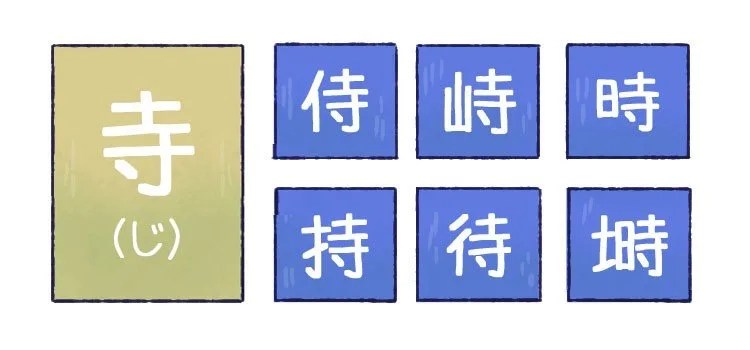
You may still be confused about what components or phonetic compositions form a kanji. The best way to understand what I am talking about is to see it in practice. Pay close attention to the image below:
Here we find the ideogram 寺 which means Buddhist temple. Its Japanese reading (KUN YOMI) is [tera] while the Chinese reading (ON YOMI) is [ji]. All the other kanji found in the image have 寺 on the right side. This makes all the ideograms in the image have the same Chinese reading or on yomi as [ji].
It is worth clarifying that this rule is not absolute. Many Japanese ideograms have more than one Chinese reading. Some kanji also gain the Chinese reading dakuten. For example, an ideogram with the reading か may sometimes also have the reading が. It is impossible to determine this without knowing the ideogram or at least the words it forms. This dakuten reading exists to make the pronunciation of the words formed by the ideogram more beautiful.
Therefore, you should keep in mind that there are thousands of kanji, some are composed of one or more components (radicals or kanji). Others have zero or more than one Chinese reading (on yomi). With this in mind, you can start to assimilate some ideograms through their components and discover their reading. It is not an easy process; you need to have a good knowledge of Japanese to easily read ideograms and words formed by radicals/kanji with their Chinese readings.
Kanji with the same ON YOMI readings
The table below shows examples of ideograms that have a phonetic component (or a radical/kanji with reading) see below:
| Radical, Component | Reading | Kanji, Ideograms |
|---|---|---|
| 几 | ki | 机, 肌, 飢 |
| 亡 | bou | 忙, 忘, 盲, 荒, 望, 妄 |
| 干 | kan | 汗, 肝, 奸, 刊, 岸 |
| 五 | go | 伍, 吾, 唔, 圄, 寤, 悟, 晤, 梧, 牾, 珸, 衙, 語, 齬 |
| 己 | ki | 起, 記, 紀, 忌 |
| 咢 | gaku | 咢, 愕, 萼, 蕚, 諤, 鄂, 鍔, 顎, 鰐, 鶚, 齶 |
| 工 | kou | 紅, 空, 虹, 江, 攻, 功, 肛 |
| 及 | kyuu | 吸, 級, 扱 |
| 士 | shi | 仕, 志, 誌 |
| 方 | hou, bou | 肪, 坊, 紡, 防, 妨, 房, 謗, 傍, 芳, 訪, 放 |
| 乍 | saku | 作, 搾, 昨, 酢, 酢 |
| 中 | chuu | 忠, 沖, 仲, 虫, 狆 |
| 化 | ka | 花, 貸, 靴 |
| 反 | han | 版, 板, 坂, 飯, 販, 叛 |
| 分 | fun | 粉, 紛, 雰 |
| 半 | han | 伴, 絆, 拌, 判 |
| 白 | haku | 伯, 拍, 泊, 迫, 舶, 狛, 柏, 箔, 珀 |
| 皮 | hi | 彼, 被, 疲, 被, 披 |
| 付 | fu | 府, 符, 附, 俯 |
| 包 | hou | 抱, 泡, 胞, 砲, 飽, 咆 |
| 可 | ka | 河, 何, 荷, 苛, 呵, 歌 |
| 古 | ko | 居, 固, 故, 枯, 個, 湖, 箇, 沽, 姑, 苦 |
| 生 | sei | 姓, 性, 星, 牲, 惺 |
| 正 | sei | 征, 政, 症, 整, 性, 牲 |
| 旱 | kan | 悍, 捍, 旱, 桿, 稈, 駻 |
| 析 | seki | 晰, 析, 淅, 皙, 蜥 |
| 司 | shi | 伺, 詞, 嗣, 飼 |
| 且 | so | 粗, 祖, 狙, 阻, 組 |
| 旦 | tan | 但, 胆, 疸, 担 |
| 令 | rei | 冷, 鈴, 零, 齢, 鈴 |
| 立 | ryuu | 竜, 滝, 粒, 笠, 龍 |
| 申 | shin | 神, 伸, 呻, 押, 紳 |
| 召 | shou | 招, 沼, 昭, 紹, 詔, 照 |
| 安 | an | 案, 按, 鞍, 鮟 |
| 同 | dou | 洞, 胴, 桐, 恫, 銅, 洞, 筒 |
| 寺 | ji | 侍, 持, 時, 塒, 峙 |
| 旬 | jun | 洵, 殉, 恂 |
| 各 | kaku | 格, 喀, 閣, 額 |
| 圭 | kei | 掛, 桂, 畦, 珪, 罫, 鮭, 硅 |
| 糸 | kei | 系, 係, 繋 |
| 結 | ketsu | 潔 |
| 光 | kou | 恍 |
| 交 | kou | 校, 絞, 狡, 較, 郊, 効, 咬 |
| 共 | kyou, kou | 供, 恭, 洪, 哄 |
| 次 | shi | 姿, 諮, 資 |
| 成 | sei | 盛, 誠, 筬, 城 |
| 朱 | shu | 株, 珠, 殊, 蛛 |
| 我 | ga | 峨, 蛾, 餓, 俄, 鵞 |
| 甫 | ho | 浦, 捕, 哺, 匍, 補, 蒲, 輔, 舗 |
| 見 | ken | 硯, 蜆, 現 |
| 辰 | shin | 唇, 振, 賑, 震, 娠 |
| 肖 | shou | 宵, 消, 硝 |
| 弟 | tei | 第, 剃. 涕 |
| 廷 | tei | 庭, 挺, 艇 |
| 良 | ryou | 郎, 浪, 朗, 狼, 廊 |
| 直 | choku, shoku | 植, 埴, 殖, 稙 |
| 長 | chou | 張, 帳, 脹 |
| 非 | hi | 悲, 緋, 誹, 鯡, 琲, 扉 |
| 朋 | hou | 崩, 棚, 硼 |
| 果 | ka | 課, 菓, 踝, 顆 |
| 官 | kan | 棺, 管, 館 |
| 末 | matsu | 抹, 末, 沫, 秣, 茉, 靺 |
| 奇 | ki | 崎, 埼, 椅 |
| 其 | ki | 期, 欺, 棋, 基, 旗 |
| 金 | kin | 欽, 錦, 銀 |
| 采 | sai | 彩, 菜, 採 |
| 青 | sei | 清, 靖, 精, 晴, 請, 情, 鯖, 静 |
| 昔 | shaku | 借, 惜, 錯 |
| 尚 | shou | 常, 裳, 掌 |
| 昌 | shou | 娼, 唱, 菖, 晶 |
| 禺 | guu | 遇, 寓, 隅, 偶 |
| 扁 | hen | 編, 偏, 篇, 蝙 |
| 則 | soku | 側, 測, 惻 |
| 相 | sou | 想, 箱, 霜 |
| 湘 | shou | 廂 |
| 莫 | baku | 摸, 膜, 漠, 博, 縛, 幕 |
| 高 | kou | 縞, 稿, 藁 |
| 曹 | sou | 遭, 槽, 糟 |
| 曽 | sou | 贈, 僧, 憎, 増 |
| 童 | dou | 撞, 憧, 瞳 |
| 義 | gi | 儀, 議, 犠, 蟻, 艤 |

Leave a Reply