
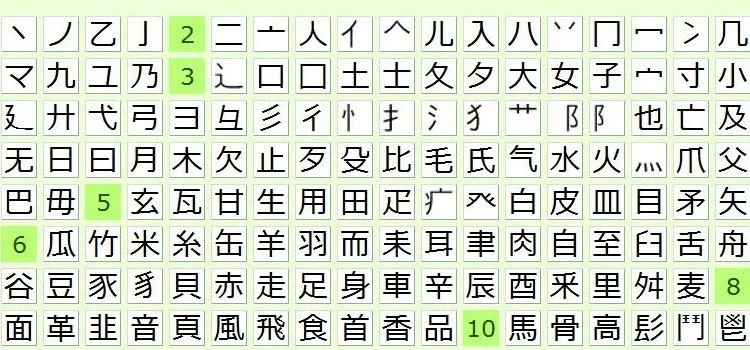
The kanji are classified in dictionaries according to their main components. These components are called Radical in English and 部首 (bushu) in Japanese. Its original name in Japanese is composed of the Kanji 部 which means division, section, group, and with the kanji 首 which means head or neck.
The Radicals are kanji or elements that are found in the structure of an ideogram. Many think that a kanji is formed from several radicals, to some extent yes. However, each kanji only has one radical which is its head. This radical may or may not relate to the final meaning of the kanji word. The radicals are not named and not all have their own meaning, currently there are about 214 radicals.
How is a Kanji formed using Radicals? See below radicals being applied and forming different Kanji:
- 時 – The radical of this kanji is “sun” 日 – The meaning of the Kanji is “time”;
- 詩 – The radical of this kanji is “word” 言 – The meaning of the kanji is “poetry, poem”;
- 持 – The radical of this kanji is “hand” 扌 – The meaning of the kanji is “to hold”,
Did you notice that the radical for hand 扌 is not the same as 手. This is because not all radicals are being used in the Japanese language, most are used only to form the kanji. You should also know that Japanese is full of ideograms that have the same meaning.
Table of Contents
Classification of Radicals – Position
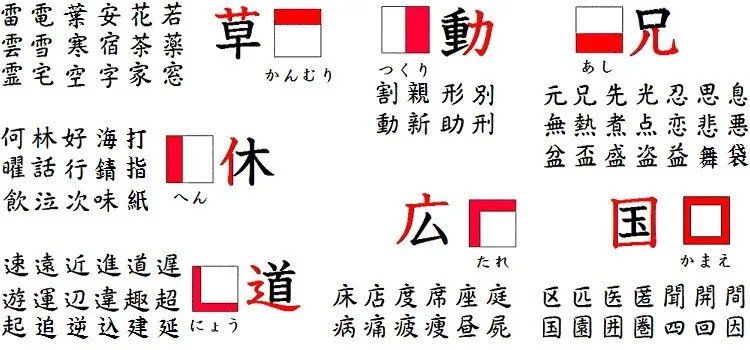
The radicals are usually classified by the position they occupy in the kanji, knowing this position will facilitate their use.
| Japanese | Position |
| へん (hen) | left side |
| つくり (tsukuri) | right side |
| かんむり (kanmuri) | on top |
| あし (ashi) | below |
| かまえ (kamae) | surrounds the kanji from outside to inside |
| たれ (tare) | covers the kanji from top to bottom. |
| にょう (nyou) | left side encompassing also the bottom part of the kanji. |
The image below will show examples of kanji and the positions of their radicals.
What are the benefits of knowing the Radicals of Japanese?
It is important to have knowledge of these elements that compose the kanji, so it becomes easier to find a certain kanji in a dictionary and even understand the essence of its meaning.
Another advantage is that over time, you will be able to identify meaning in the ideograms and will stop seeing only strokes. Knowledge of these elements helps you remember the kanji and its meaning.
We know that several words in the Japanese language are the combination of kanji, for example: 手紙 (letter) is the combination of the ideograms for hand (手) and paper (紙). The same thing happens with the radicals. See some examples:
- The Kanji and Radical 木 (tree) can become 林 (grove) and 森 (forest);
- The Kanji and Radical 木 together with 几 (table) form the kanji 机 (desk / work table)
Imagine that you found a kanji and do not know its meaning or how to look for it. You can use the radical search on the jisho website or on Windows itself in a feature called IME Pad, which can be accessed by right-clicking on the Japanese language keyboard icon in the Windows taskbar.
Table with Radicals of Japanese
Below we have a table with the main radicals, the number of strokes, a meaning, and their position in Japanese. Remembering that the meanings of the radicals are quite varied, do not cling to that, it is just an informative meaning.
| Strokes | Radical | Position | Meaning | Notes |
|---|---|---|---|---|
| 1 | ⼀ | one, horizontal stroke | ||
| 1 | ⼁ | vertical stroke | ||
| 1 | ⼂ | dot | ||
| 1 | ⼃ | stroke for a diagonal stroke | ||
| 1 | ⼄ | the second | ||
| 1 | ⺃ | the second | variant of ⼄(おつ) | |
| 1 | ⼅ | vertical stroke with a hook | ||
| 2 | ⼆ | two | ||
| 2 | ⼇ | かんむり | cap, top | |
| 2 | ⼈ | person | ||
| 2 | ⺅ | person | variant of ⼈(ひと)important | |
| 2 | ? | かんむり | person | variant of ⼈(ひと) |
| 2 | ⼉ | human legs | important | |
| 2 | ⼊ | enter | ||
| 2 | ⼋ | eight | ||
| 2 | ⼌ | けいがまえ | include | |
| 2 | ⼍ | かんむり | covering, crown | important |
| 2 | ⼎ | へん | ice | |
| 2 | ⼏ | table | ||
| 2 | ⺇ | かんむり | wind | variant of ⼏(きにょう) |
| 2 | ⼐ | container, open box | ||
| 2 | ⼑ | knife, sword | ||
| 2 | ⺉ | つくり | knife, sword | variant of ⼑(かたな)important |
| 2 | ⼒ | power | ||
| 2 | ⼓ | wrap | ||
| 2 | ⼔ | つくり | spoon | |
| 2 | ⼕ | box | ||
| 2 | ⼖ | はこがまえ | hide, hide | |
| 2 | ⼗ | ten | ||
| 2 | ⼘ | oracle | ||
| 2 | ⼙ | つくり | stamp, a seal | |
| 2 | ⼚ | cliff | important | |
| 2 | ⼛ | private, Katakana Mu | ||
| 2 | ⼜ | again, the right hand | ||
| 3 | ⼝ | mouth | ||
| 3 | ⼞ | くにがまえ | border, territorial borders | important |
| 3 | ⼟ | earth | ||
| 3 | ⼠ | man, scholar, samurai | ||
| 3 | ⼡ | the following | ||
| 3 | ⼢ | あし | go slowly | |
| 3 | ⼣ | night | ||
| 3 | ⼤ | big, large | ||
| 3 | ⼥ | woman | ||
| 3 | ⼦ | child, son | ||
| 3 | ⼧ | かんむり | roof, house | important |
| 3 | ⼨ | inch (2.25 cm) | ||
| 3 | ⼩ | small | ||
| 3 | ⺌ | かんむり | small | variant of ⼩(しょう) |
| 3 | ⺐ | つくり | lame leg | |
| 3 | ⼫ | たれ | corpse, awning | |
| 3 | ⼬ | sprout | ||
| 3 | ⼭ | mountain | ||
| 3 | ⼮ | meandering river | ||
| 3 | 川 | river | variant of ⼮(まがりがわ) | |
| 3 | ⼯ | work, carpenter, skill | ||
| 3 | ⼰ | ego | ||
| 3 | ⼱ | cloth | ||
| 3 | ⼲ | dry, shield | ||
| 3 | ⺓ | young, slight | ||
| 3 | ⼴ | たれ | slanted roof | important |
| 3 | ⼵ | にょう | to move, stretch | |
| 3 | ⼶ | あし | the folded hands | |
| 3 | ⼷ | dart | ||
| 3 | ⼸ | bow (in archery) | ||
| 3 | ⼹ | pig’s head | ||
| 3 | ⺕ | pig’s head | variant of ⼹(けいがしら) | |
| 3 | ⺔ | pig’s head | variant of ⼹(けいがしら) | |
| 3 | ⼺ | つくり | hair-style, rays of light | |
| 3 | ⼻ | へん | step, step, street, go | important |
| 3 | ⺾ | かんむり | grass | variant of ⾋(くさ)important |
| 3 | ⻌ | にょう | road, on foot, advance | variant of ⾡(しんにょう)important |
| 3 | ⻏ | つくり | village, country, city | variant of ⾢(むら)important |
| 3 | ⻖ | へん | hill, mound | variant of ⾩(こざと)important |
| 3 | ⺍ | かんむり | katakana Tsu | |
| 3 | ⺖ | へん | heart, mind, spirit | variant of ⼼(こころ)important |
| 3 | ⺘ | へん | hand | variant of ⼿(て)important |
| 3 | ⺡ | へん | water | variant of ⽔(みず)important |
| 3 | ⺨ | へん | beast | variant of ⽝(いぬ)important |
| 4 | ⼼ | heart, mind, spirit | ||
| 4 | ⺗ | あし | heart, mind, spirit | variant of ⼼(こころ) |
| 4 | ⼽ | spear, weapon | ||
| 4 | ⼾ | door | ||
| 4 | ⼿ | hand | ||
| 4 | ⽀ | branch | ||
| 4 | ⽁ | つくり | activity, to strike, hit | |
| 4 | ⺙ | つくり | activity, to strike, hit | variant of ⽁(ぼくづくり)important |
| 4 | ⽂ | literature, letters | ||
| 4 | ⽃ | つくり | Big Dipper, shell, 18 liters | |
| 4 | ⽄ | つくり | axe | |
| 4 | ⽅ | direction, flag | ||
| 4 | ⽆ | no | ||
| 4 | ⽇ | sun, day, hour | ||
| 4 | ⽈ | to say | ||
| 4 | ⽉ | moon, month, period | ||
| 4 | ⺝ | へん | moon, month, period | variant of ⽉(つき) |
| 4 | ⽊ | tree, wood | ||
| 4 | ⽋ | to lack, yawn | ||
| 4 | ⽌ | to stop | ||
| 4 | ⽍ | death and die, to decompose | ||
| 4 | ⽎ | つくり | shaft of a spear, action | |
| 4 | ⽏ | no, mother | ||
| 4 | ⽐ | to compare | ||
| 4 | ⽑ | hair | ||
| 4 | ⽒ | family, clan | ||
| 4 | ⽓ | steam, air | ||
| 4 | ⽔ | water | ||
| 4 | ⽕ | fire | ||
| 4 | ⺣ | あし | fire | variant of ⽕(ひ)important |
| 4 | ⽖ | claw, nail | ||
| 4 | ⺤ | かんむり | claw, nail | variant of ⽖(つめ) |
| 4 | 爫 | かんむり | claw, nail | variant of ⽖(つめ) |
| 4 | ⽗ | father | ||
| 4 | ⽘ | to mix | ||
| 4 | ⽙ | へん | wood of division | |
| 4 | ⽚ | wood of division | ||
| 4 | ⽜ | cow | ||
| 4 | ⽝ | dog | ||
| 4 | ⺭ | へん | altar, festival, religious service | variant of ⽰(しめす) |
| 4 | 㓁 | liquid | variant of ⽹(あみ) | |
| 4 | ⺹ | かんむり | age, old age | variant of ⽼(おいかんむり) |
| 5 | ⽞ | darkness | ||
| 5 | ⽟ | jewels | ||
| 5 | ⽡ | tile | ||
| 5 | ⽢ | sweet | ||
| 5 | ⽣ | birth, to be born, alive | ||
| 5 | ⽤ | to use | ||
| 5 | ⽥ | rice field | ||
| 5 | ⽦ | piece of cloth | ||
| 5 | ⺪ | へん | piece of cloth | variant of ⽦(ひき) |
| 5 | ⽧ | たれ | disease | important |
| 5 | ⽨ | かんむり | open legs, departure | |
| 5 | ⽩ | white | ||
| 5 | ⽪ | skin, to hide | ||
| 5 | ⽫ | dish, bowl | ||
| 5 | ⽬ | eye | ||
| 5 | ⽭ | halberd | ||
| 5 | ⽮ | arrow | ||
| 5 | ⽯ | stone | ||
| 5 | ⽰ | altar, festival, religious service | ||
| 5 | ⽱ | footprint | ||
| 5 | ⽲ | へん | grain | important |
| 5 | ⽳ | hole, cave | ||
| 5 | ⽴ | to rest | ||
| 5 | 氺 | water | variant of ⽔(みず) | |
| 5 | ⺫ | かんむり | liquid | variant of ⽹(あみ) |
| 5 | ? | liquid | variant of ⽹(あみ) | |
| 5 | ⻂ | へん | clothing | variant of ⾐(ころも)important |
| 5 | ⺛ | no | variant of ⽆(むにょう) | |
| 6 | ⽵ | bamboo | ||
| 6 | ⺮ | かんむり | bamboo | variant of ⽵(たけ)important |
| 6 | ⽶ | rice | ||
| 6 | ⽷ | thread | ||
| 6 | ⽸ | clay jar | ||
| 6 | ⽹ | liquid | ||
| 6 | ⽺ | sheep | ||
| 6 | ⺷ | sheep | variant of ⽺(ひつじ) | |
| 6 | 羽 | feather, wing | ||
| 6 | ⽻ | feather, wing | variant of 羽(はね) | |
| 6 | ⽼ | age, old age | ||
| 6 | ⽽ | and also | ||
| 6 | ⽾ | へん | plowed | |
| 6 | ⽿ | ear | ||
| 6 | ⾀ | writing brush | ||
| 6 | ⾁ | meat, meats | ||
| 6 | ⾂ | retainer, minister | ||
| 6 | ⾃ | ego | ||
| 6 | ⾄ | to arrive | ||
| 6 | ⾅ | mortar, quern | ||
| 6 | ⾆ | tongue | ||
| 6 | ⾇ | opposite, to err | ||
| 6 | ⾈ | ship, boat | ||
| 6 | ⾉ | limit | ||
| 6 | ⾊ | color | ||
| 6 | ⾋ | grass, plant | ||
| 6 | ⾌ | かんむり | tiger | |
| 6 | ⾍ | worm, insect | ||
| 6 | ⾎ | blood | ||
| 6 | ⾏ | ぎょうがまえ | to go | important |
| 6 | ⾐ | clothing | ||
| 6 | ⾑ | cap, to the west | ||
| 6 | ⻃ | cap, to the west | variant of ⾑(にし) | |
| 6 | ⽠ | melon | variant of ⽠(うり) | |
| 7 | ⾨ | gate, door | ||
| 7 | ⾩ | hill | ||
| 7 | ⾪ | つくり | to capture | |
| 7 | ⾫ | small bird | ||
| 7 | ⾬ | rain | ||
| 7 | ⻗ | かんむり | rain | variant of ⾬(あめ)important |
| 7 | ⾭ | blue, green | ||
| 7 | ⻘ | blue, green | variant of ⾭(あお) | |
| 7 | ⾮ | wrong, no | ||
| 7 | ⻟ | へん | food, to eat | variant of ⾷(しょく) |
| 7 | ⻫ | similar | variant of ⿑(せい) | |
| 8 | ⾦ | metal, gold, mineral | ||
| 8 | ⻑ | long | ||
| 8 | ⾨ | もんがまえ | gate, door | |
| 8 | ⾩ | hill | ||
| 8 | ⾪ | つくり | to capture | |
| 8 | ⾫ | small bird | ||
| 8 | ⾬ | rain | ||
| 8 | ⻗ | かんむり | rain | variant of ⾬(あめ)important |
| 8 | ⾭ | blue, green | ||
| 8 | ⻘ | blue, green | variant of ⾭(あお) | |
| 8 | ⾮ | wrong, no | ||
| 8 | ⻟ | へん | food, to eat | variant of ⾷(しょく) |
| 8 | ⻫ | similar | variant of ⿑(せい) | |
| 9 | ⾯ | face, surface | ||
| 9 | ⾰ | leather | ||
| 9 | ⾲ | leek | ||
| 9 | ⾳ | sound, noise | ||
| 9 | ⾴ | つくり | head, page | important |
| 9 | ⾵ | wind | ||
| 9 | ⾶ | to fly | ||
| 9 | ⾷ | food, to eat | ||
| 9 | ⾸ | head | ||
| 9 | ⾹ | perfume | ||
| 10 | ⾺ | horse | ||
| 10 | ⾻ | bone | ||
| 10 | ⾼ | high | ||
| 10 | ⾽ | かんむり | long hair | |
| 10 | ⾾ | もんがまえ | fight | |
| 10 | ⾿ | herbs | ||
| 10 | ⿀ | tripod | ||
| 10 | ⿁ | demon | ||
| 10 | ⾱ | leather | variant of (なめしがわ) | |
| 11 | ⿂ | fish | ||
| 11 | ⿃ | bird | ||
| 11 | ⿄ | salt | ||
| 11 | ⿅ | deer | ||
| 11 | ⿆ | wheat | ||
| 11 | ⿇ | hemp | ||
| 11 | ⻩ | yellow | variant of ⿈(き) | |
| 11 | 黒 | black | variant of ⿊(くろ) | |
| 11 | ⻲ | turtle | variant of ⿔(かめ) | |
| 12 | ⿈ | yellow | ||
| 12 | ⿉ | millet | ||
| 12 | ⿊ | black | ||
| 12 | ⿋ | to embroider | ||
| 12 | ⻭ | tooth | variant of ⿒(は) | |
| 13 | ⿌ | frog | ||
| 13 | ⿍ | tripod | ||
| 13 | ⿎ | drum | ||
| 13 | ⿏ | mouse, rat | ||
| 14 | ⿐ | nose | ||
| 14 | ⿑ | similar | ||
| 15 | ⿒ | tooth | ||
| 16 | ⿓ | dragon | ||
| 16 | ⿔ | turtle | ||
| 17 | ⿕ | flute |

Leave a Reply